
401(k) to Gold IRA Rollover: IRS Rules, Steps and Pitfalls
How a 401(k) to gold IRA rollover works under IRS rules: direct vs 60-day rollovers, the 20% withholding trap, the one-per-year rule, and mistakes to avoid.
Published Facts last checked
This is an independently operated affiliate website. We may receive compensation if you contact or become a customer of Augusta Precious Metals through links or phone numbers on this site. How this site is funded.
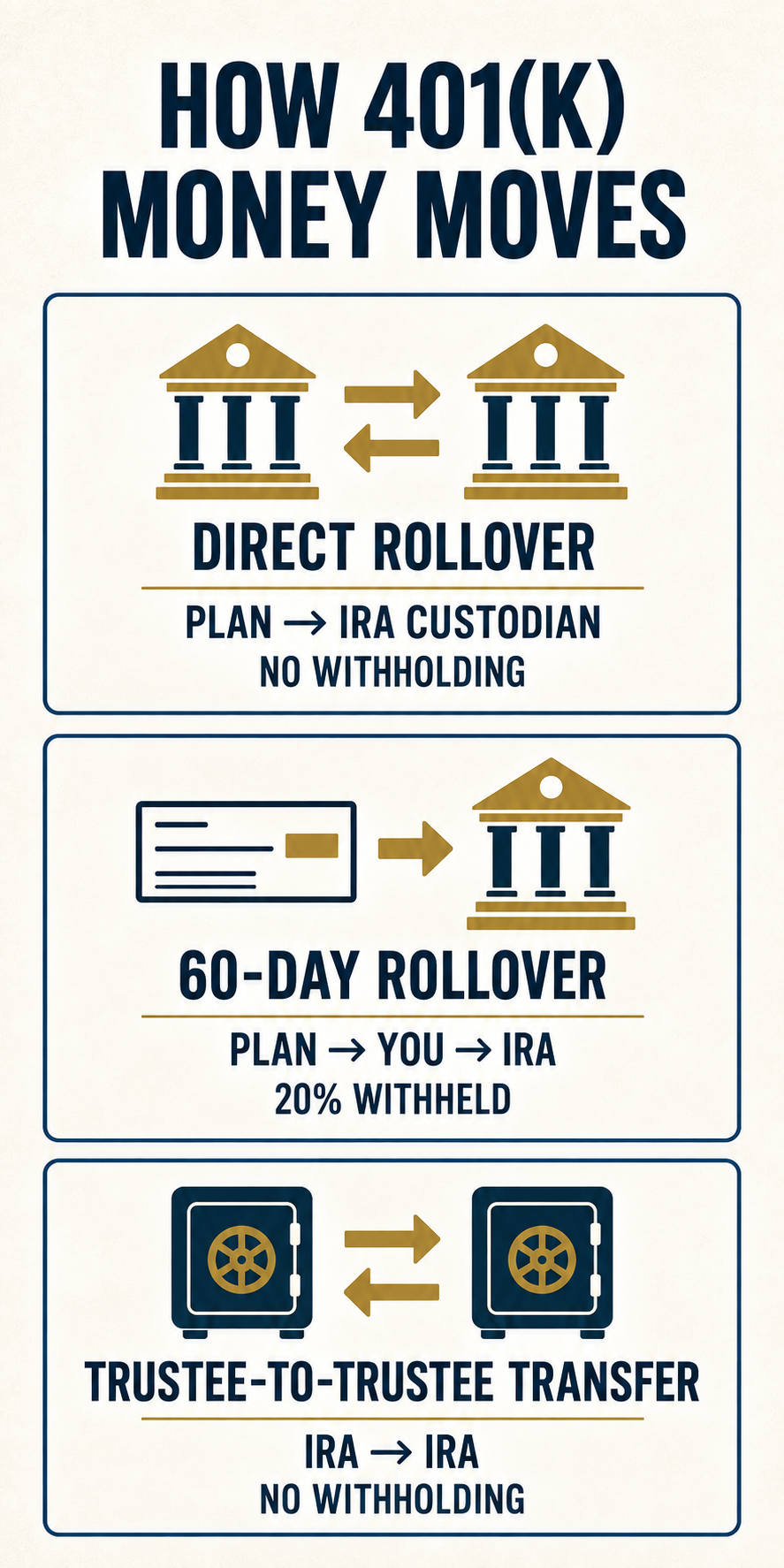
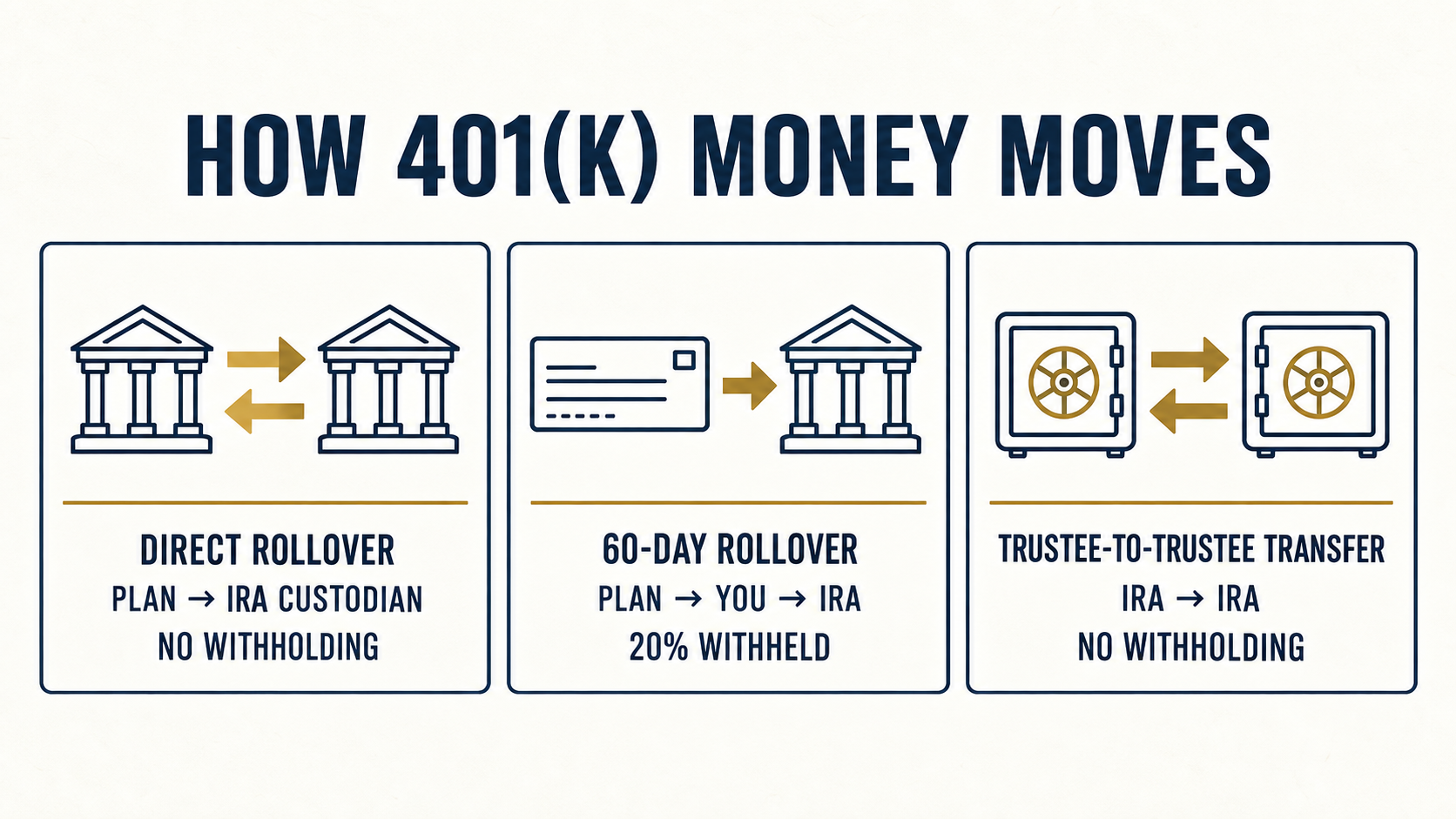
A 401(k) to gold IRA rollover moves money from an employer retirement plan into a self-directed IRA, where a custodian holds physical metals that qualify under IRS rules in a depository. The IRS treats a rollover done the right way as a tax-free move between retirement accounts. Done the wrong way, part of it can become taxable income. The difference comes down to three things: whether your plan allows the distribution, how the money moves, and whether you meet the deadlines.
This page explains the mechanics using the IRS's own rules. Whether moving retirement savings into precious metals makes sense for you, and how much, is a separate decision to make with a licensed financial or tax professional who knows your full situation.
First: Can You Move the Money at All?
Before anything else, your 401(k) plan has to allow a distribution. The IRS is explicit that "the plan is not required to allow distributions for every possible distributable event" and that "the plan document must clearly state when a distribution will be made."
For your own salary deferrals, the IRS says a plan may permit a distribution when you:
- Leave the employer
- Reach age 59½
- Suffer a hardship
Hardship distributions can't be rolled over to an IRA, so 401(k) rollovers generally happen after you've left the employer, or while you're still working if your plan allows distributions at 59½. The only reliable answer for your account is in your plan's summary plan description, or from your plan administrator.
The Three Ways Money Can Move
If your money is in the federal Thrift Savings Plan rather than a 401(k), the TSP has its own process; see our TSP to gold IRA guide.
The IRS recognizes three ways to move retirement money, and they're treated very differently:
| Method | How it works | Tax withheld | Deadline | One-per-year limit applies? |
|---|---|---|---|---|
| Direct rollover | Your 401(k) plan pays the new IRA custodian directly | None | None in practice | No |
| 60-day (indirect) rollover | The plan pays you, and you deposit the money into the IRA yourself | 20% mandatory from an employer plan | 60 days | Not for plan-to-IRA rollovers |
| Trustee-to-trustee transfer | One IRA custodian pays another directly (IRA to IRA) | None | None in practice | No |
In the IRS's words, with a direct rollover "you can ask your plan administrator to make the payment directly to another retirement plan or to an IRA… No taxes will be withheld from your transfer amount." A check made payable to the new IRA custodian for your benefit is treated the same way for withholding, even if it's mailed to you: the IRS says "a distribution sent to you in the form of a check payable to the receiving plan or IRA is not subject to withholding."
The 20% Withholding Trap
If your 401(k) plan pays the money to you instead of to the new custodian, federal law requires the plan to withhold 20%, "even if you intend to roll it over later," according to the IRS. To roll over the full amount, you have to make up the withheld 20% from other money within 60 days.
Here's what that looks like on a $50,000 distribution paid to you:
| Amount | |
|---|---|
| Distribution from your 401(k) | $50,000 |
| Mandatory 20% federal withholding | −$10,000 |
| Check you actually receive | $40,000 |
| Needed in the IRA within 60 days to roll over the full amount | $50,000 |
| Amount you'd have to add from other funds | $10,000 |
If you deposit only the $40,000, the IRS treats the $10,000 that wasn't rolled over as taxable income, and it may also be subject to the 10% additional tax on early distributions if you're under 59½ and no exception applies. The IRS gives its own example: a 42-year-old who received a $10,000 distribution with $2,000 withheld and rolled over only $8,000 "will report $2,000 as taxable income" and "must also pay the 10% additional tax on early distributions on the $2,000 unless she qualifies for an exception."
A direct rollover avoids all of this, because no withholding applies.
The 60-Day Rule
When money is paid to you, you generally have 60 days from the day you receive it to deposit it into an IRA. Miss the deadline and, according to IRS Publication 590-A, "amounts not rolled over within the 60-day period don't qualify for tax-free rollover treatment," and a 10% additional tax may also apply.
The IRS does allow relief in some cases. Under Revenue Procedure 2020-46, you can self-certify that you missed the deadline for one of 12 specific reasons, such as a financial institution's error, a serious illness, or a death in the family, if you complete the rollover as soon as practicable. Self-certification isn't a guarantee: the IRS says it "is not a waiver by the IRS of the 60-day rollover requirement," and it can still disagree on audit.
The One-Rollover-Per-Year Rule
You'll often read that you can only do one rollover a year. That rule is narrower than it sounds. According to the IRS, you can make "only one rollover from an IRA to another (or the same) IRA in any 12-month period, regardless of the number of IRAs you own." It doesn't apply to:
- Rollovers from an employer plan, such as a 401(k), to an IRA
- Trustee-to-trustee transfers between IRAs
- Conversions from a traditional IRA to a Roth IRA
So a 401(k) rollover doesn't use up your one IRA-to-IRA rollover for the year, and moving money between IRAs by trustee-to-trustee transfer avoids the limit entirely. The IRS also says it "cannot waive the IRA one-rollover-per-year rule."
Traditional and Roth Money
The IRS's rollover chart sets out which accounts can roll into which. The short version:
- Pre-tax 401(k) to a traditional IRA: allowed, and not taxed when done as a rollover.
- Pre-tax 401(k) to a Roth IRA: allowed, but the IRS requires you to include the amount in income, like a Roth conversion.
- Roth 401(k) to a Roth IRA: allowed. The IRS says "a rollover from a designated Roth account can only be made to another designated Roth account or to a Roth IRA."
Precious metals IRAs come in both traditional and Roth versions. How a Roth conversion would affect your taxes is a question for a tax professional.
The Rollover, Step by Step
Every provider's paperwork is different, but the general sequence is the same:
- Confirm eligibility with your plan administrator. Ask whether you can take a distribution now, whether the plan will make a direct rollover to an IRA custodian, and what the plan needs from you.
- Open a self-directed IRA with a custodian that holds precious metals. The custodian must be a bank or an entity approved by the IRS. The IRS publishes a list of approved nonbank trustees and custodians; banks aren't on it, and investor regulators note the list "is not a complete list of every custodian." Our guide to gold IRA custodians explains how to check one.
- Request a direct rollover to the new custodian, for your benefit, rather than a check payable to you.
- Choose the metals once the money arrives. Only metals that qualify under the tax code can go into the IRA. Buying anything else, such as most collectible coins, is treated as a distribution of the amount spent. See IRA-eligible gold and silver for what the tax code allows.
- The custodian pays the dealer, and the metals go to a depository. The IRS says IRA bullion must be "in the physical possession of a bank or an IRS-approved nonbank trustee."
- Keep every document. Keep the plan's distribution paperwork, the custodian's confirmation, and the tax forms you receive for that year, and share them with whoever prepares your taxes.
If you're considering Augusta Precious Metals for this process, our how Augusta works page covers its steps specifically.
Mistakes That Cost People Money
- Taking a check payable to yourself. This triggers 20% withholding and starts the 60-day clock. A direct rollover avoids both.
- Doing two IRA-to-IRA rollovers within 12 months. The second can become taxable. Use trustee-to-trustee transfers instead.
- Storing IRA metals at home. In McNulty v. Commissioner (2021), the U.S. Tax Court held that an IRA owner who took possession of coins bought through a self-directed IRA LLC had received a taxable distribution equal to their cost, and upheld penalties. The IRS applies the same rule when an IRA-owned LLC buys the bullion. Our guide to home storage gold IRAs covers the case.
- Assuming the custodian checked the dealer. A joint investor alert from the SEC, FINRA, and NASAA says self-directed IRA custodians "DO NOT evaluate the quality or legitimacy of any investment" and that "using a legitimate custodian to buy an investment DOES NOT make that investment legitimate." Our guide to checking a gold IRA company lists where to look.
- Not getting costs in writing. The CFTC and FINRA advise asking for "all fees, costs, commissions, and agreed retail price in writing BEFORE signing," and call it a red flag if that isn't available. Our fees breakdown shows what published account fees look like, and what to ask about the markup on metals.
Questions to Ask Before You Start
Your 401(k) plan administrator:
- Am I eligible to take a distribution now, and under which rule?
- Will you send a direct rollover to an IRA custodian, and what paperwork do you need?
- How long does processing usually take, and will the check be mailed to me or to the custodian?
The IRA custodian and the metals dealer:
- Is the custodian a bank or on the IRS list of approved nonbank trustees?
- What are all the account fees: setup, annual administration, storage, and any fees to close or transfer the account?
- What is the price over melt value on each product, and what would the dealer pay to buy it back today?
- Which depository will hold the metals, and is storage segregated or commingled?
The CFTC's 10 things to ask before buying physical metals is worth reading alongside this list, whichever company you use.
The Bottom Line
A 401(k) to gold IRA rollover is a routine move under IRS rules when it's done as a direct rollover: no withholding, no 60-day deadline, and no effect on the one-per-year limit. Most problems come from checks paid to you, missed deadlines, home storage schemes, and costs you didn't get in writing. Confirm your plan's rules first, keep the money moving directly between institutions, and bring in a tax professional for anything specific to your situation.
Common questions
Frequently asked questions
- Can I roll over my 401(k) into a gold IRA without paying tax?
- A direct rollover from a 401(k) to a traditional IRA isn't taxed when done under IRS rules: the IRS says no taxes are withheld from a direct rollover, and IRS Publication 590-A shows no 10% additional tax applies to it. Rolling pre-tax 401(k) money into a Roth IRA is different: the IRS treats that amount as income, like a Roth conversion. Confirm your own situation with a tax professional.
- Can I roll over my 401(k) while I'm still working?
- Only if your plan allows it. The IRS says a plan isn't required to allow distributions for every possible event, and the plan document must state when a distribution can be made. Many plans permit distributions after you leave the employer or reach age 59½. Check your summary plan description or ask your plan administrator.
- How long do I have to complete a 401(k) rollover?
- If the plan pays the money to you, you have 60 days to deposit it into an IRA. A direct rollover, where the plan pays the new IRA custodian, avoids that deadline because the money never passes through your hands.
- Does the one-rollover-per-year rule apply to 401(k) rollovers?
- No. The IRS limit of one IRA-to-IRA rollover in any 12-month period doesn't apply to rollovers from an employer plan to an IRA, or to trustee-to-trustee transfers between IRAs.
- Can I keep the gold from my IRA at home?
- No. The IRS says IRA bullion must be in the physical possession of a bank or an IRS-approved nonbank trustee, including when an IRA-owned LLC buys it. In McNulty v. Commissioner (2021), the U.S. Tax Court held that an IRA owner who took home coins bought through a self-directed IRA LLC had received a taxable distribution, and upheld penalties.
Evidence
Sources
- IRS — Rollovers of retirement plan and IRA distributionsas of 2026-09-24
- IRS — Publication 590-A, Contributions to Individual Retirement Arrangementsas of 2026-09-24
- IRS — Rollover chart (PDF)as of 2026-09-24
- IRS — When can a retirement plan distribute benefits?as of 2026-09-24
- IRS — Rev. Proc. 2020-46 (60-day rollover self-certification), Internal Revenue Bulletin 2020-45as of 2026-09-24
- IRS — Retirement plans FAQs regarding IRAs (bullion storage)as of 2026-09-24
- IRS — Approved nonbank trustees and custodiansas of 2026-09-24
- Internal Revenue Code § 3405 (mandatory 20% withholding) — Cornell LIIas of 2026-09-24
- Internal Revenue Code § 408 (IRAs, collectibles rule) — Cornell LIIas of 2026-09-24
- SEC / FINRA / NASAA — Self-Directed IRAs and the Risk of Fraud (Investor.gov)as of 2026-09-24
- CFTC / FINRA — 10 Things to Ask Before Buying Physical Gold, Silver, or Other Metalsas of 2026-09-24
Keep researching
Related research
- How Augusta Precious Metals WorksThe actual step-by-step Augusta Precious Metals process: the web conference, account setup, funding, choosing metals, storage, and ongoing service.
- Augusta Precious Metals Fees: The Full BreakdownWhat Augusta Precious Metals charges for a gold IRA: setup, custodian, and storage fees, the current fee promotion, and what isn't published online.
- Augusta Precious Metals Pros and ConsA balanced look at Augusta Precious Metals: real advantages backed by ratings, and genuine drawbacks like the $50,000 minimum and phone-only buying.