
IRA-Eligible Gold and Silver: What the Tax Code Actually Allows
There's no IRS list of approved coins. What the tax code allows in an IRA, the purity standards it points to, and how common gold and silver coins measure up.
Published Facts last checked
This is an independently operated affiliate website. We may receive compensation if you contact or become a customer of Augusta Precious Metals through links or phone numbers on this site. How this site is funded.
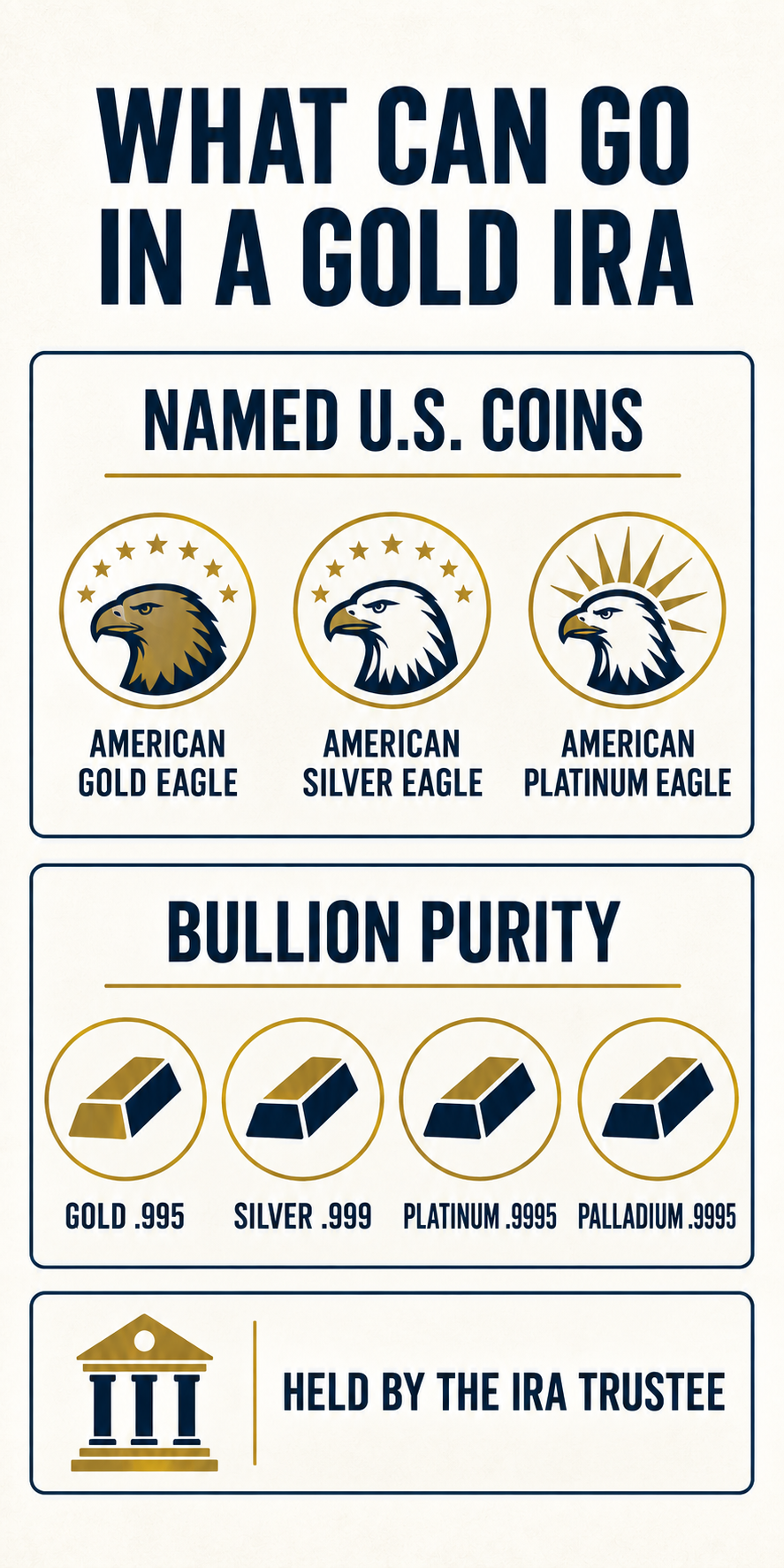
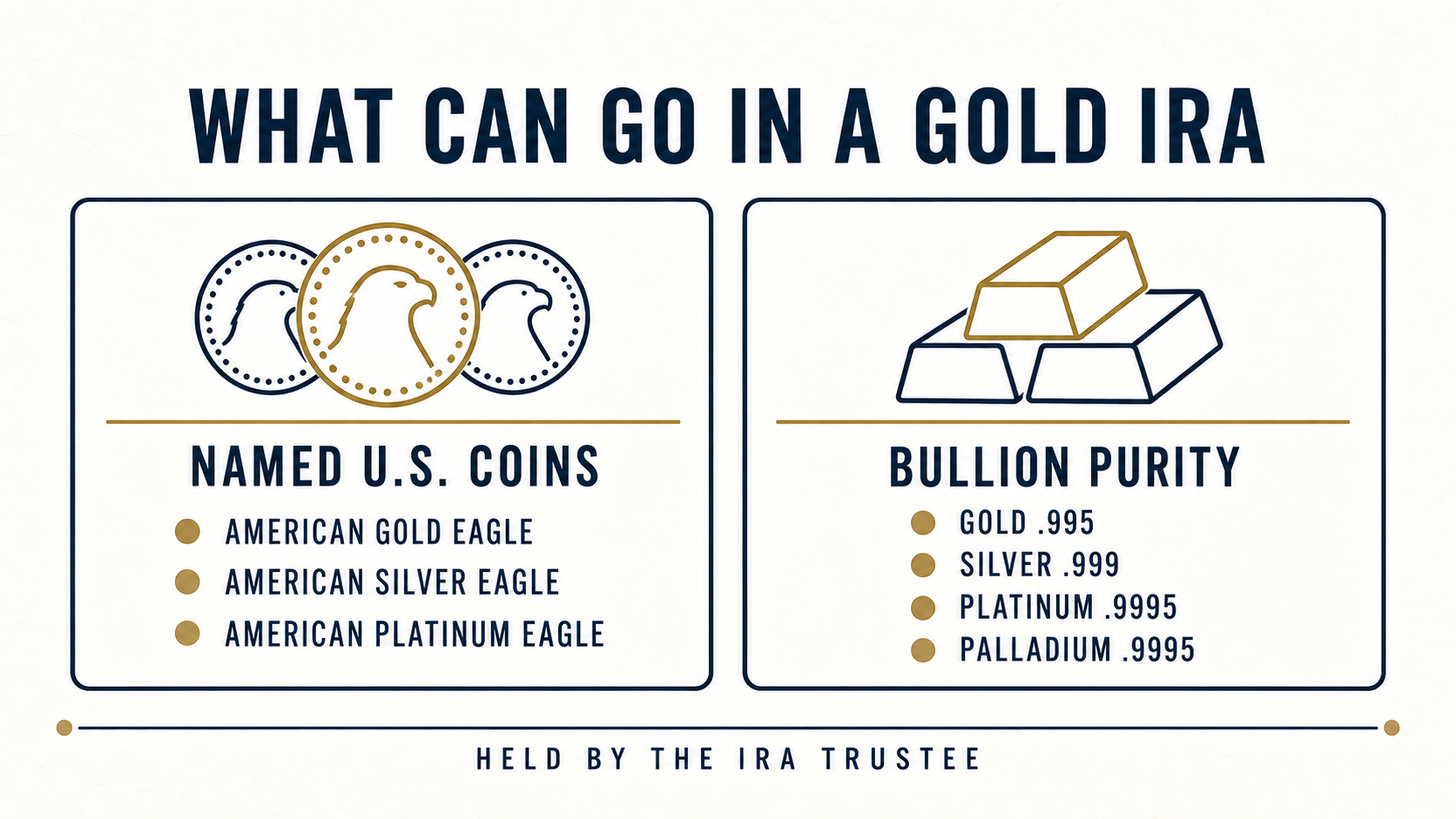
You'll see "IRS-approved gold" in a lot of gold IRA marketing. The IRS doesn't approve coins or bars, and it publishes no list of eligible products. What decides whether a metal can go in an IRA is a short section of the tax code, section 408(m), and the exchange purity standards it refers to. This page explains what that section says, how common coins measure up against it, and where the official sources run out.
The Rule: Metals Are Collectibles, With Two Exceptions
The tax code treats "any metal" and "any stamp or coin" as a collectible. If an IRA buys a collectible, section 408(m)(1) says the purchase "shall be treated… as a distribution from such account in an amount equal to the cost to such account of such collectible." In plain terms, the IRA is treated as if it paid that money out to you.
Section 408(m)(3) then carves out two exceptions:
- Certain U.S. coins, named in the law. The gold coins described in 31 U.S.C. § 5112(a)(7)–(10), which are the American Gold Eagles; the silver coin in § 5112(e), the American Silver Eagle; the platinum coins in § 5112(k), American Platinum Eagles; and "a coin issued under the laws of any State."
- Bullion of a minimum purity. "Any gold, silver, platinum, or palladium bullion of a fineness equal to or exceeding the minimum fineness that a contract market… requires for metals which may be delivered in satisfaction of a regulated futures contract."
The statute adds a condition that the bullion be "in the physical possession of a trustee." The IRS's own summary in Publication 590-A: "Your IRA can invest in one, one-half, one-quarter, or one-tenth ounce U.S. gold coins, or one-ounce silver coins minted by the Treasury Department. It can also invest in certain platinum coins and certain gold, silver, palladium, and platinum bullion."
The Purity Standards the Law Points To
The tax code doesn't state a purity number. It borrows one from the futures exchanges. These are the delivery standards in the exchanges' own rulebooks:
| Metal | Exchange contract | Minimum purity for delivery |
|---|---|---|
| Gold | COMEX Gold Futures (100 oz) | .995 fine |
| Silver | COMEX Silver Futures | .999 fine |
| Platinum | NYMEX Platinum Futures | 99.95% |
| Palladium | NYMEX Palladium Futures | 99.95% |
Two caveats. First, these are exchange rules the statute refers to, not IRS figures; no IRS publication we found states them. Second, COMEX also lists a gold kilo contract that requires .9999, and the statute doesn't say which gold contract applies. The .995 standard of the main gold contract is the figure most commonly cited.
How Common Coins Measure Up
This table applies the statute to widely sold coins, using each issuer's official purity. "Named in the law" means the coin qualifies under the first exception regardless of purity. "Purity route" means any eligibility depends on meeting the exchange standard, plus trustee possession.
| Coin | Official purity | Route under § 408(m)(3) |
|---|---|---|
| American Gold Eagle | 22-karat; the law specifies 33.931 g containing one troy ounce of fine gold, about 91.67% | Named in the law |
| American Silver Eagle | .999 (per 31 U.S.C. § 5112(e)) | Named in the law |
| American Platinum Eagle | Set by the Treasury | Named in the law |
| American Gold Buffalo | 99.99% (per 31 U.S.C. § 5112(a)(11)) | Not named; purity route |
| American Palladium Eagle | .9995 (per 31 U.S.C. § 5112(a)(12)) | Not named; purity route |
| Canadian Gold Maple Leaf | 99.99% (Royal Canadian Mint) | Purity route |
| Canadian Silver Maple Leaf | 99.99% (Royal Canadian Mint) | Purity route |
| Austrian Gold Philharmonic | 999.9 (Münze Österreich) | Purity route |
| Austrian Silver Philharmonic | 999 (Münze Österreich) | Purity route |
| British Gold Britannia | 999.9 since 2013; 22-karat before 2013 (Royal Mint) | Purity route; pre-2013 coins fall below .995 |
| British Silver Britannia | 999 since 2013; .958 before 2013 (Royal Mint) | Purity route; pre-2013 coins fall below .999 |
| South African Gold Krugerrand | 22-karat, 9167 parts pure (Rand Refinery) | Not named, and below .995 |
A point that surprises people: no IRS publication, ruling, or court decision we found names the Maple Leaf, Philharmonic, Britannia, or Krugerrand at all. The coin-by-coin eligibility lists you see online are inferences from purity, the same inference this table makes. It's a reasonable reading of the statute, not an IRS determination.
Krugerrands
The Krugerrand isn't one of the named U.S. coins, and at 22-karat it falls below the .995 gold standard, so on its face it doesn't meet either route. You may also read that Krugerrands are "banned." The only U.S. ban was a 1986 law prohibiting their import, which Congress repealed in 1993. It had nothing to do with IRAs.
Proof coins
The same law that authorizes American Eagles also authorizes proof versions, and dealers point to that as the basis for putting proof Eagles in IRAs. We found no IRS ruling or publication that addresses proof Eagles specifically. If you're considering one, ask the IRA custodian in writing whether it will hold the coin and on what basis.
Possession Matters as Much as Purity
Meeting the purity standard isn't enough on its own. The bullion must be in the physical possession of the IRA's trustee. The IRS says the exception covers bullion "if a bank or approved non-bank trustee keeps physical possession of it."
The IRS has applied this strictly. In a 2002 private letter ruling, which can't be cited as precedent, it treated IRA metals held by non-bank safekeeping firms, rather than by the IRA trustee, as collectibles, because "this limited exception applies only if a certain type of bullion is in the physical possession of the IRA trustee." And the U.S. Tax Court has held that metals an IRA owner keeps at home are a taxable distribution. Our guide to home storage gold IRAs covers that case in detail.
Bars as Well as Coins
The bullion exception isn't limited to coins. It covers "gold, silver, platinum, or palladium bullion" of the required purity, which is why IRAs can also hold bars. The same possession requirement applies.
Questions to Ask Before You Buy
Because there's no official product list, the practical check is to ask, in writing, before any purchase:
- Under which part of § 408(m)(3) does this product qualify: a named U.S. coin, or bullion meeting the exchange purity standard?
- What is its official purity, according to the mint or refiner?
- Will my IRA custodian accept and hold it, and who will have physical possession?
- What is the price over melt value, and what would the dealer pay to buy it back today?
Our guide to gold IRA custodians explains what custodians do and don't check, and our 401(k) to gold IRA rollover guide covers how money gets into the account in the first place.
The Bottom Line
There's no such thing as an IRS-approved coin. The tax code allows certain named U.S. coins, such as American Gold and Silver Eagles, and bullion that meets exchange purity standards: .995 for gold, .999 for silver, and 99.95% for platinum and palladium. Everything else about eligibility is inference from those rules, and in every case a bank or approved trustee must hold the metals. Get the product's basis for eligibility in writing before you buy.
Common questions
Frequently asked questions
- Is there an IRS list of approved coins for IRAs?
- No. The IRS doesn't publish a list of approved coins or bars. Eligibility comes from section 408(m) of the tax code, which names certain U.S. coins and allows bullion that meets the minimum purity a regulated futures exchange requires. What the IRS approves is nonbank trustees and custodians, not products.
- What purity does gold need to be IRA-eligible?
- The tax code points to the minimum fineness a regulated futures contract requires for delivery. The COMEX gold futures contract requires at least .995 fine gold, and the COMEX silver contract requires .999 fine silver. NYMEX platinum and palladium contracts require 99.95% purity. American Gold Eagles are allowed by name even though they're 22-karat gold.
- Are Krugerrands allowed in an IRA?
- No IRS statement names the Krugerrand either way. It isn't one of the U.S. coins listed in the tax code, and the Rand Refinery describes it as 22-karat gold, 9167 parts per 10,000 pure, which is below the .995 purity of the COMEX gold contract. On those facts it doesn't meet either route in the statute.
- Can proof American Eagle coins go in an IRA?
- The law that authorizes American Eagles also authorizes proof versions, which is the basis for claims that proofs qualify. We found no IRS ruling or publication that addresses proof Eagles specifically. Ask the IRA custodian in writing whether it will hold a proof coin, and on what basis, before you buy.
Evidence
Sources
- Internal Revenue Code § 408(m) (collectibles) — Cornell LIIas of 2026-09-24
- 31 U.S.C. § 5112 (U.S. coin specifications) — Cornell LIIas of 2026-09-24
- IRS — Publication 590-A (collectibles exception)as of 2026-09-24
- IRS — Investments in collectibles in individually directed qualified plan accountsas of 2026-09-24
- CFTC — COMEX Rulebook filing, Chapter 113 Gold Futures (April 2025)as of 2026-09-24
- CFTC — COMEX Rulebook filing, Chapter 112 Silver Futures (August 2021)as of 2026-09-24
- CME Group — NYMEX Rulebook Chapter 105, Platinum Futuresas of 2026-09-24
- CME Group — NYMEX Rulebook Chapter 106, Palladium Futuresas of 2026-09-24
- IRS — Private Letter Ruling 200217059 (bullion not held by the trustee)as of 2026-09-24
- Royal Canadian Mint — Gold Maple Leaf specificationsas of 2026-09-24
- Münze Österreich — Vienna Philharmonic gold and silver specificationsas of 2026-09-24
- The Royal Mint — Britannia purity historyas of 2026-09-24
- Rand Refinery — Krugerrand specificationsas of 2026-09-24
- 22 U.S.C. § 5051 (former Krugerrand import ban, repealed 1993) — Cornell LIIas of 2026-09-24
Keep researching
Related research
- 401(k) to Gold IRA Rollover: IRS Rules, Steps and PitfallsHow a 401(k) to gold IRA rollover works under IRS rules: direct vs 60-day rollovers, the 20% withholding trap, the one-per-year rule, and mistakes to avoid.
- Home Storage Gold IRAs: What the IRS and the Tax Court SayCan you keep IRA gold at home? What the tax code, the IRS, and the Tax Court's McNulty decision say about home storage and IRA-owned LLCs, and what it cost.
- Gold IRA Custodians: What They Do and How to Check OneWhat a gold IRA custodian legally is, what it does and doesn't check, the fees it charges, and how to verify a custodian with the IRS, FDIC, OCC, or your state.