
How to Check a Gold IRA Company and Spot a Scam
Retail metals dealers aren't federally regulated, so checking falls to you. Where to look, the red flags regulators list, and what enforcement cases found.
Published Facts last checked
This is an independently operated affiliate website. We may receive compensation if you contact or become a customer of Augusta Precious Metals through links or phone numbers on this site. How this site is funded.
Regulators have brought cases against a number of precious metals dealers that sold to retirement savers, while other companies have clean records. From the outside they can look alike, and the safeguards people assume are in place often aren't. This page explains who does and doesn't oversee gold IRA companies, the red flags regulators list, what recent enforcement cases actually found, and where you can check a company's record yourself.
Who Oversees Gold IRA Companies
Less oversight exists than most people assume:
- The dealer. The CFTC and FINRA say plainly: "Retail metal dealers are not regulated at the federal level." They point consumers to their state's attorney general or securities regulator.
- The IRA custodian. The custodian is regulated, but regulators say it doesn't check the dealer. NASAA's 2024 advisory: "IRA custodians do not vet precious metals dealers or their sales practices." Our guide to gold IRA custodians covers what custodians do.
- The metals. The tax code sets which metals can go in an IRA, but no one checks the price you pay for them.
That leaves the most important check, whether the company and its prices are fair, to you.
Red Flags Regulators List
NASAA's 2024 advisory on precious metals and coin investments lists warning signs, including a seller that:
- Uses cold calling or unsolicited emails
- Runs advertisements designed to instill fear about the economy
- Touts political or religious affinity
- Creates a false sense of urgency by claiming limited supply
- Advises investors to liquidate their existing retirement investments
- Fails to disclose commissions and fees in writing
The FTC adds that in precious metals scams, "whether the market is up or down, they'll tell you that there's no better time than now to invest." And the CFTC and FINRA note that if someone "suggests what to buy, how much, or when, that's advice and they might be required to register."
The single most useful check comes from the same CFTC and FINRA advisory: "Ask for all fees, costs, commissions, and agreed retail price in writing BEFORE signing… If fees are not available in writing before your purchase, that is a red flag."
What Enforcement Cases Found
Regulators have brought several cases against metals dealers that targeted retirement savers. Some ended in court findings; others are allegations that haven't been proven. This table keeps the two apart:
| Case | What regulators said | Status |
|---|---|---|
| Red Rock Secured (CFTC) | Customers paid "over $69 million for silver and gold Canadian Red-Tailed Hawk (RTH) coins worth only $30 million, reflecting mark-ups of between 91.89% and 129.97%" | Consent order, 2024: about $39 million in restitution, $5.1 million disgorgement, and a $12.25 million penalty |
| Safeguard Metals (CFTC) | Customers "paid an average markup of 71% when the customer agreement stated the defendants would charge a maximum markup of 23% on silver coins" | Liability order, 2023; final judgment, 2025: $25.6 million in restitution and a $25.6 million penalty |
| Regal Assets (CFTC and California DFPI) | Case filed in 2023 | Default judgments, 2024: over $21.9 million in restitution and over $27.3 million in penalties |
| TMTE, known as Metals.com (CFTC and 30 states) | Alleged over $185 million taken, including more than $140 million in retirement savings, with overcharges averaging 100% to more than 300% | Allegations filed in 2020; we did not find a final resolution |
| Lear Capital (state securities regulators) | At least 42 state and territory regulators investigated alleged overcharges | Resolved through a bankruptcy plan paying $5.5 million to investors; regulators' allegations, not court findings |
Two patterns stand out. The central problem in these cases was price: markups far above what customers were told or could see. And several involved moving retirement money: the March 2024 joint warning from the CFTC, FINRA, and NASAA says fraudulent dealers "often push the idea of retirement plan rollovers," because "that's where most people have the bulk of their investing dollars."
Where to Check a Company's Record
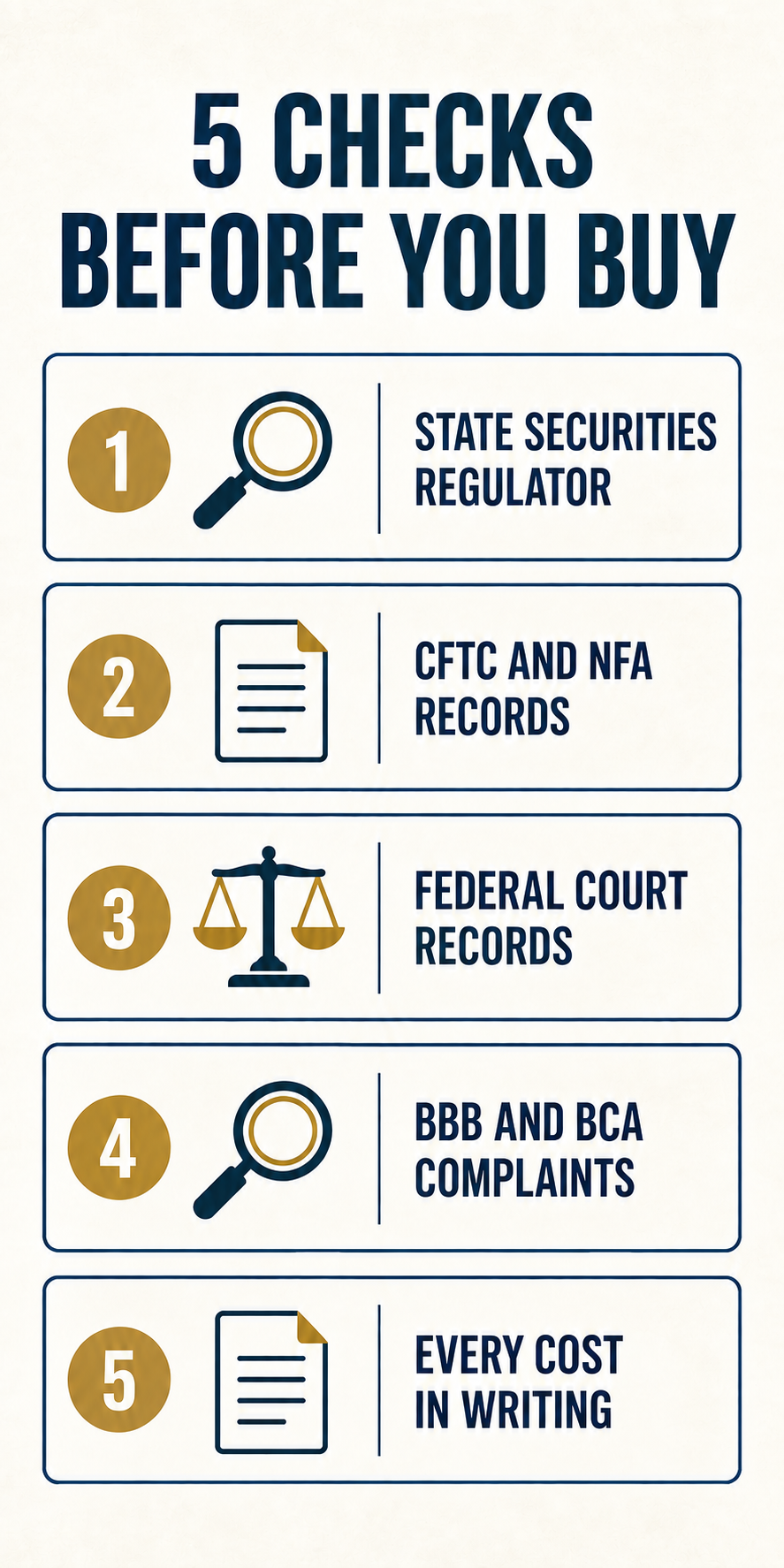
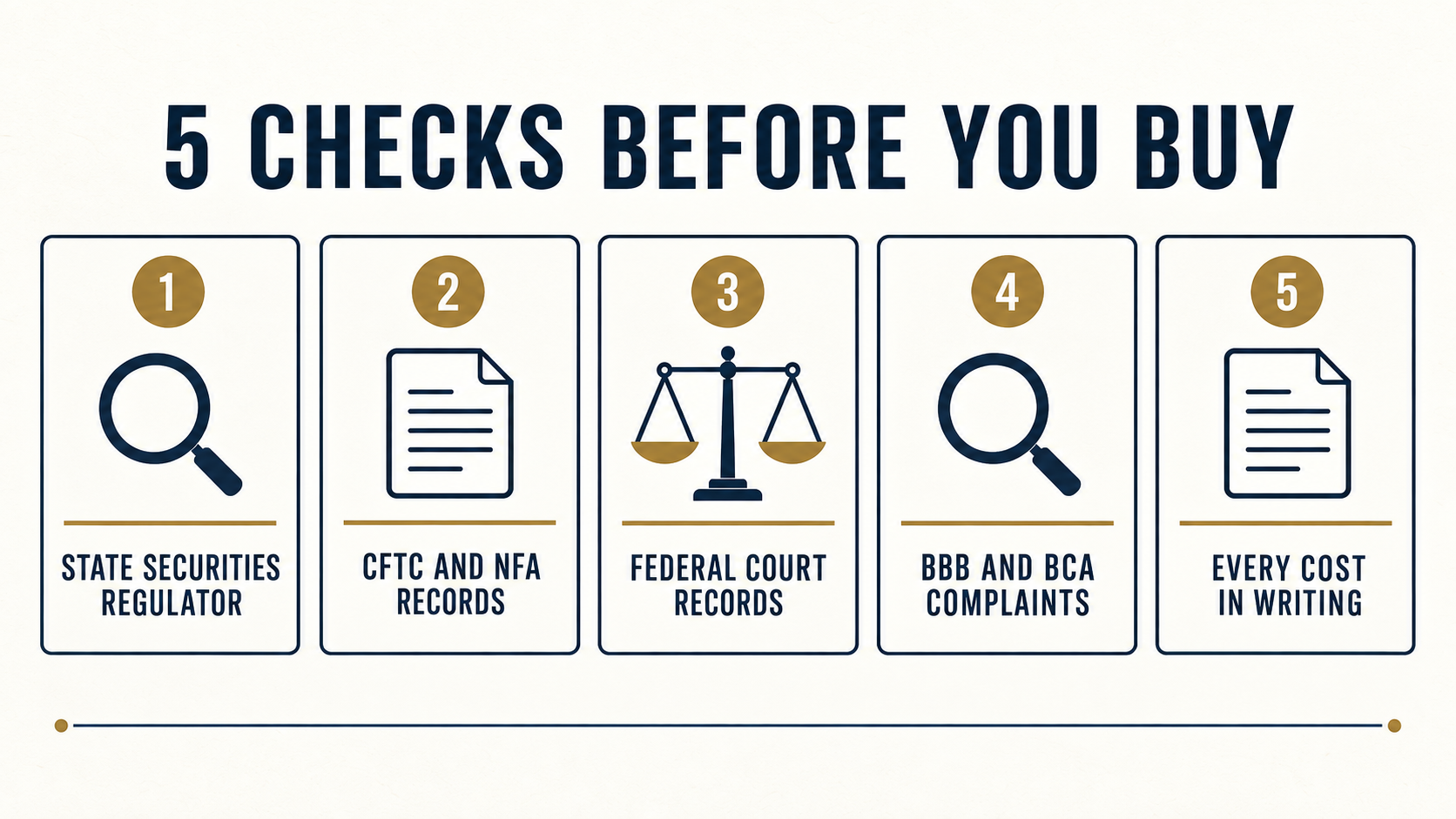
None of these checks is complete on its own. Together they take an hour or two:
- Your state securities regulator and attorney general. Federal regulators direct consumers here for metals dealers. NASAA's site has a directory of state securities regulators.
- CFTC enforcement actions and the NFA's BASIC database. The CFTC's check page links to NFA BASIC for registration and disciplinary history, and the CFTC publishes its enforcement actions. Many retail metals dealers aren't registered with the CFTC at all, so a missing registration isn't a finding on its own; an enforcement action is.
- Federal court records. PACER charges $0.10 per page, capped at $3 per document; court opinions are free, and you're only billed if you run up more than $30 in a quarter. CourtListener, run by the nonprofit Free Law Project, offers a free archive of many federal records, though it may not be complete or current.
- BBB and BCA complaint files. The Better Business Bureau and Business Consumer Alliance are private organizations, not regulators. Read the complaints themselves and how the company responded, not just the letter grade.
- Written costs. Before you sign, get the account fees, the price over melt value on each product, and the dealer's current buyback price in writing.
- The custodian and the metals. Confirm the custodian with its regulator, and confirm the products qualify. See our guides to gold IRA custodians and IRA-eligible gold and silver.
What a Clean Record Does and Doesn't Tell You
A company with no complaints, actions, or lawsuits on record has cleared a meaningful bar, and it's worth knowing. But a clean record doesn't make a specific price fair, and a single complaint or lawsuit isn't proof of wrongdoing. Even the CFTC notes that inclusion on its RED List of unregistered foreign firms "does not mean that the CFTC or a court has concluded that a violation… has occurred." Weigh the whole record, and rely most on what the company is willing to put in writing.
For an example of this process applied to one company, see our research on Augusta Precious Metals' complaint record.
The Bottom Line
Retail gold IRA dealers aren't federally regulated, and custodians don't vet them, so the checking is yours to do. Look the company up with your state regulator, in CFTC and court records, and in its BBB and BCA complaint files. Watch for fear-based pitches, urgency, and advice to liquidate your retirement investments. Above all, get every cost in writing before you sign. For how money moves into a gold IRA once you've chosen a company, see our 401(k) to gold IRA rollover guide.
Common questions
Frequently asked questions
- Are gold IRA companies regulated?
- Not at the federal level, according to the CFTC and FINRA, which say retail metal dealers are not regulated federally and point consumers to their state attorney general or securities regulator. The IRA custodian is regulated, but regulators say custodians don't vet dealers or their sales practices.
- What are the red flags of a gold IRA scam?
- NASAA's 2024 advisory lists cold calls or unsolicited emails, advertising designed to instill fear about the economy, political or religious affinity pitches, false urgency based on limited supply, advice to liquidate existing retirement investments, and failure to disclose commissions and fees in writing.
- How do I check a gold IRA company's record?
- Contact your state securities regulator, search the CFTC's enforcement actions and the NFA's BASIC database, search federal court records through PACER or the free CourtListener archive, and read the company's complaint files at the Better Business Bureau and Business Consumer Alliance, not just its rating.
- Does a clean record mean a company can be trusted?
- No. A clean record means no complaints or actions were found, not that none will happen, and it says nothing about whether a specific price is fair. Get every fee and the price over melt value in writing before you sign, whichever company you use.
Evidence
Sources
- CFTC / FINRA — 10 Things to Ask Before Buying Physical Gold, Silver, or Other Metalsas of 2026-09-24
- NASAA — Informed Investor Advisory: Precious Metals and Coin Investments (July 2024)as of 2026-09-24
- CFTC — Release 8881-24: CFTC, FINRA and NASAA joint warning (March 2024)as of 2026-09-24
- FTC — Investment Scamsas of 2026-09-24
- CFTC — Release 8898-24: Red Rock Secured consent orderas of 2026-09-24
- CFTC — Release 9139-25: Safeguard Metals final judgmentas of 2026-09-24
- CFTC — Release 8812-23: Safeguard Metals consent orderas of 2026-09-24
- CFTC — Release 9001-24: Regal Assets default judgmentsas of 2026-09-24
- CFTC — Release 8254-20: TMTE (Metals.com) complaintas of 2026-09-24
- D.C. Department of Insurance, Securities and Banking — Lear Capital resolutionas of 2026-09-24
- CFTC — Check registration and backgroundas of 2026-09-24
- CFTC — Enforcement actionsas of 2026-09-24
- PACER — Pricing: How fees workas of 2026-09-24
- SEC / FINRA / NASAA — Self-Directed IRAs and the Risk of Fraud (Investor.gov)as of 2026-09-24
Keep researching
Related research
- Gold IRA Custodians: What They Do and How to Check OneWhat a gold IRA custodian legally is, what it does and doesn't check, the fees it charges, and how to verify a custodian with the IRS, FDIC, OCC, or your state.
- 401(k) to Gold IRA Rollover: IRS Rules, Steps and PitfallsHow a 401(k) to gold IRA rollover works under IRS rules: direct vs 60-day rollovers, the 20% withholding trap, the one-per-year rule, and mistakes to avoid.
- IRA-Eligible Gold and Silver: What the Tax Code Actually AllowsThere's no IRS list of approved coins. What the tax code allows in an IRA, the purity standards it points to, and how common gold and silver coins measure up.