
Home Storage Gold IRAs: What the IRS and the Tax Court Say
Can you keep IRA gold at home? What the tax code, the IRS, and the Tax Court's McNulty decision say about home storage and IRA-owned LLCs, and what it cost.
Published Facts last checked
This is an independently operated affiliate website. We may receive compensation if you contact or become a customer of Augusta Precious Metals through links or phone numbers on this site. How this site is funded.
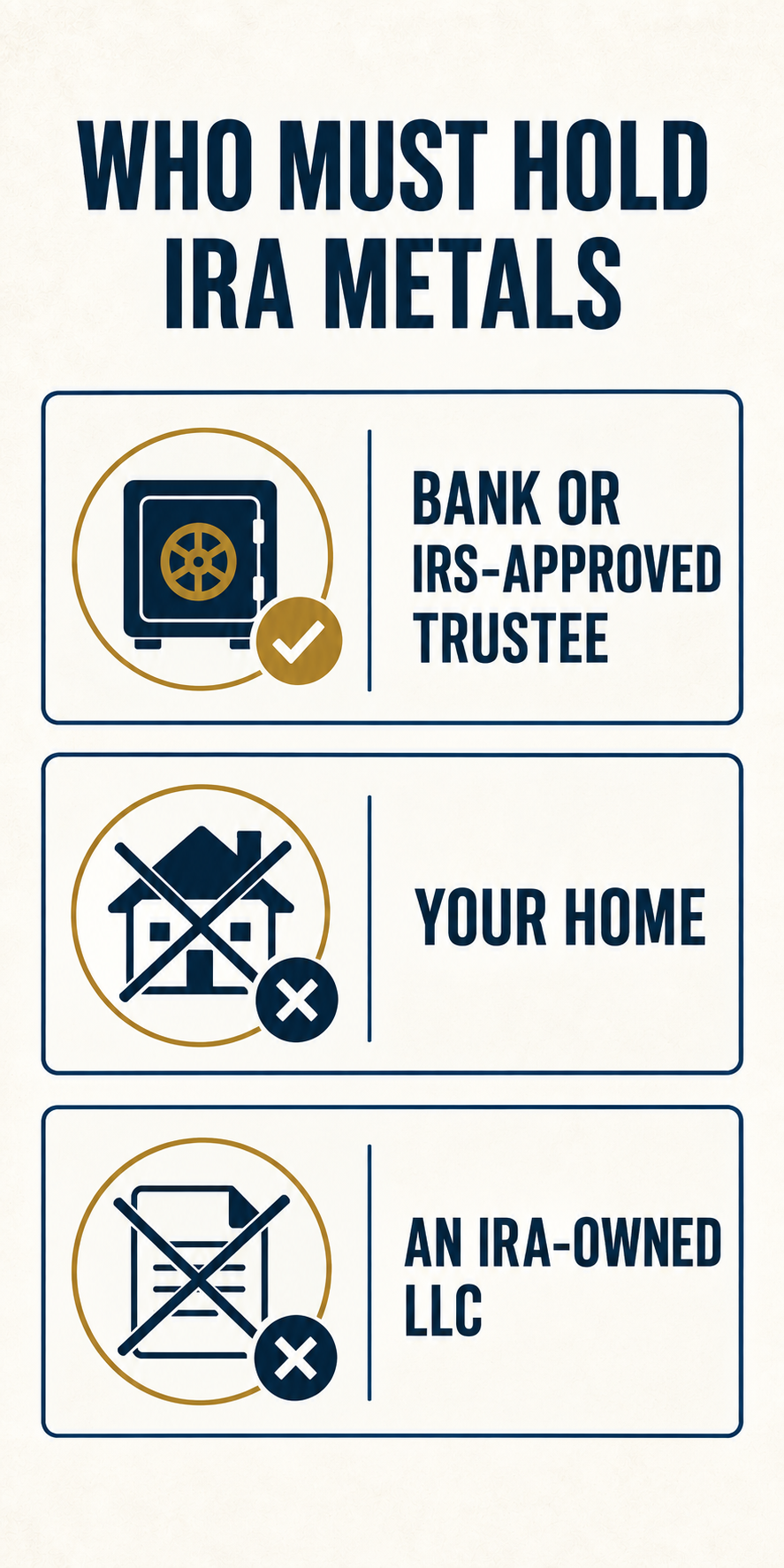

"Home storage gold IRA" is a pitch you'll still find online: set up a self-directed IRA, have it own an LLC, buy coins through the LLC, and keep them in your own safe. The tax code, the IRS, and the U.S. Tax Court all say that doesn't work. This page explains the rule, the 2021 court case that tested it, what it cost the people involved, and what legitimate storage looks like.
The Rule: A Trustee Must Hold the Metals
The tax code treats metals and coins in an IRA as collectibles, and buying a collectible counts as a distribution from the IRA. The exception that allows certain bullion in an IRA comes with a condition: the bullion must be "in the physical possession of a trustee."
The IRS answers the home storage question directly in its IRA FAQs:
"Gold and other bullion are 'collectibles' under the IRA statutes, and the law discourages the holding of collectibles in IRAs. There is an exception for certain highly refined bullion provided it is in the physical possession of a bank or an IRS-approved nonbank trustee. This rule also applies to an indirect acquisition, such as having an IRA-owned Limited Liability Company (LLC) buy the bullion."
That last sentence is aimed at the LLC structure that home storage pitches rely on. IRS FAQs aren't formal legal authority, but a Tax Court decision is, and the court reached the same result.
The Case: McNulty v. Commissioner (2021)
McNulty v. Commissioner, 157 T.C. No. 10, is a precedential opinion of the U.S. Tax Court, decided on November 18, 2021 (docket 1377-19).
What happened. An IRA owner set up a self-directed IRA with an LLC through a promoter that marketed this arrangement. According to the opinion, the promoter's website advertised that owners "could hold the coins at their homes without tax consequences or penalties so long as the coins were 'titled' to an LLC." Through the LLC, she bought 320 one-ounce American Eagle gold coins for $374,000 in 2015 and took physical possession of the coins.
What the court held. The court found that she "received taxable distributions from her self-directed IRA equal to the cost of the AE coins upon her receipt of the coins," and it upheld accuracy-related penalties. The opinion puts her taxable distributions at $374,000 for 2015 and $37,380 for 2016, with tax deficiencies of $250,558 and $18,094 for those years.
Why. The court's reasoning went to the purpose of an IRA:
- "An owner of a self-directed IRA may not take actual and unfettered possession of the IRA assets."
- "When coins or bullion are in the physical possession of the IRA owner (in whatever capacity the owner may be acting), there is no independent oversight that could prevent the owner from invading her retirement funds."
- "Personal control over the IRA assets by the IRA owner is against the very nature of an IRA."
The court also described the promoter's website as "an advertisement of its products and services," and noted that the couple had "liquidated nearly $750,000 from their existing qualified retirement accounts to invest in a questionable internet scheme."
What the court didn't decide. The case turned on the custodial requirements of an IRA, not on the type of coin. The court said it didn't need to decide whether American Eagles count as "bullion," because the custody rule applied either way. So the lesson isn't about which coins you buy. It's about who holds them.
"Not at Home" Isn't Enough: The Trustee Must Hold Them
Legitimate storage means more than keeping the metals out of your house. The requirement is possession by the IRA's trustee. In a 2002 private letter ruling, which can't be cited as precedent, the IRS treated IRA metals held by non-bank safekeeping firms, rather than by the IRA trustee itself, as collectibles, because the exception "applies only if a certain type of bullion is in the physical possession of the IRA trustee."
Treasury regulations also set standards for nonbank trustees that hold physical assets: "Assets of accounts requiring safekeeping will be deposited in an adequate vault. A permanent record will be kept of assets deposited in or withdrawn from the vault."
In practice, gold IRAs typically use a precious metals depository arranged through the IRA custodian. What matters is that the custodian, as trustee, controls the metals on the IRA's behalf. Our guide to gold IRA custodians explains how to check one.
If You Want Metals You Can Hold Yourself
Metals you keep at home can't be IRA assets. There are two ways people end up holding metals personally, and both sit outside the IRA:
- Buying metals outside an IRA, with money that isn't in a retirement account.
- Taking a distribution of metals from the IRA. An IRA can distribute the metals themselves rather than cash. That's a distribution: IRS Publication 590-B says distributions from a traditional IRA are generally taxable in the year you receive them, and in a private letter ruling the IRS said the value of distributed bullion "will be treated as a distribution taxable to the distributee."
Which, if either, makes sense for you, and what it would cost in tax, is a question for a tax professional. What the rules make clear is that there's no version where metals sit in your home and remain in your IRA.
Questions to Ask About Storage
- Who is the IRA's trustee or custodian, and is it a bank or on the IRS list of approved nonbank trustees?
- Which depository will hold the metals, and does it hold them for the custodian on the IRA's behalf?
- Is storage segregated or commingled, and what does each cost?
- Can I get a statement listing the specific metals held for my IRA?
- If anyone suggests I can store IRA metals at home or through an LLC, what is their legal basis, in writing?
The Bottom Line
IRA-owned metals must be in the physical possession of a bank or an IRS-approved nonbank trustee. Home storage, including through an IRA-owned LLC, doesn't meet that rule, and in McNulty v. Commissioner the Tax Court treated it as a taxable distribution of the full cost, with penalties. If a company suggests otherwise, treat it as a reason for caution. For what can go into a gold IRA in the first place, see our guide to IRA-eligible gold and silver.
Common questions
Frequently asked questions
- Can I store my gold IRA at home?
- No. The IRS says the exception that allows bullion in an IRA applies only if it's in the physical possession of a bank or an IRS-approved nonbank trustee, and that the same rule applies when an IRA-owned LLC buys the bullion. In McNulty v. Commissioner (2021), the U.S. Tax Court treated coins an IRA owner kept at home as a taxable distribution.
- What is a checkbook IRA LLC, and does it allow home storage of metals?
- A checkbook IRA is a self-directed IRA that owns an LLC, which the IRA owner manages. It doesn't create an exception for metals. The IRS says the possession rule also applies to an indirect acquisition, such as having an IRA-owned LLC buy the bullion, and the McNulty case involved exactly that structure.
- What happened in McNulty v. Commissioner?
- An IRA owner used her self-directed IRA's LLC to buy American Eagle gold coins and took physical possession of them. The U.S. Tax Court held that she received taxable distributions equal to the coins' cost when she received them, including $374,000 for 2015, and upheld accuracy-related penalties.
- Can I take the metals out of my IRA and keep them at home?
- You can take a distribution of the metals themselves, but it's a distribution. IRS Publication 590-B says distributions from a traditional IRA are generally taxable in the year you receive them. How that would apply to you is a question for a tax professional.
Evidence
Sources
- U.S. Tax Court — McNulty v. Commissioner, 157 T.C. No. 10 (2021), docket 1377-19as of 2026-09-24
- IRS — Retirement plans FAQs regarding IRAs (storing bullion at home)as of 2026-09-24
- IRS — Publication 590-B, Distributions from Individual Retirement Arrangementsas of 2026-09-24
- Internal Revenue Code § 408 (IRAs, collectibles rule) — Cornell LIIas of 2026-09-24
- IRS — Private Letter Ruling 200217059 (bullion not held by the trustee)as of 2026-09-24
- eCFR — 26 CFR 1.408-2 (IRA trustee requirements)as of 2026-09-24
Keep researching
Related research
- IRA-Eligible Gold and Silver: What the Tax Code Actually AllowsThere's no IRS list of approved coins. What the tax code allows in an IRA, the purity standards it points to, and how common gold and silver coins measure up.
- Gold IRA Custodians: What They Do and How to Check OneWhat a gold IRA custodian legally is, what it does and doesn't check, the fees it charges, and how to verify a custodian with the IRS, FDIC, OCC, or your state.
- 401(k) to Gold IRA Rollover: IRS Rules, Steps and PitfallsHow a 401(k) to gold IRA rollover works under IRS rules: direct vs 60-day rollovers, the 20% withholding trap, the one-per-year rule, and mistakes to avoid.