
Gold IRA Custodians: What They Do and How to Check One
What a gold IRA custodian legally is, what it does and doesn't check, the fees it charges, and how to verify a custodian with the IRS, FDIC, OCC, or your state.
Published Facts last checked
This is an independently operated affiliate website. We may receive compensation if you contact or become a customer of Augusta Precious Metals through links or phone numbers on this site. How this site is funded.
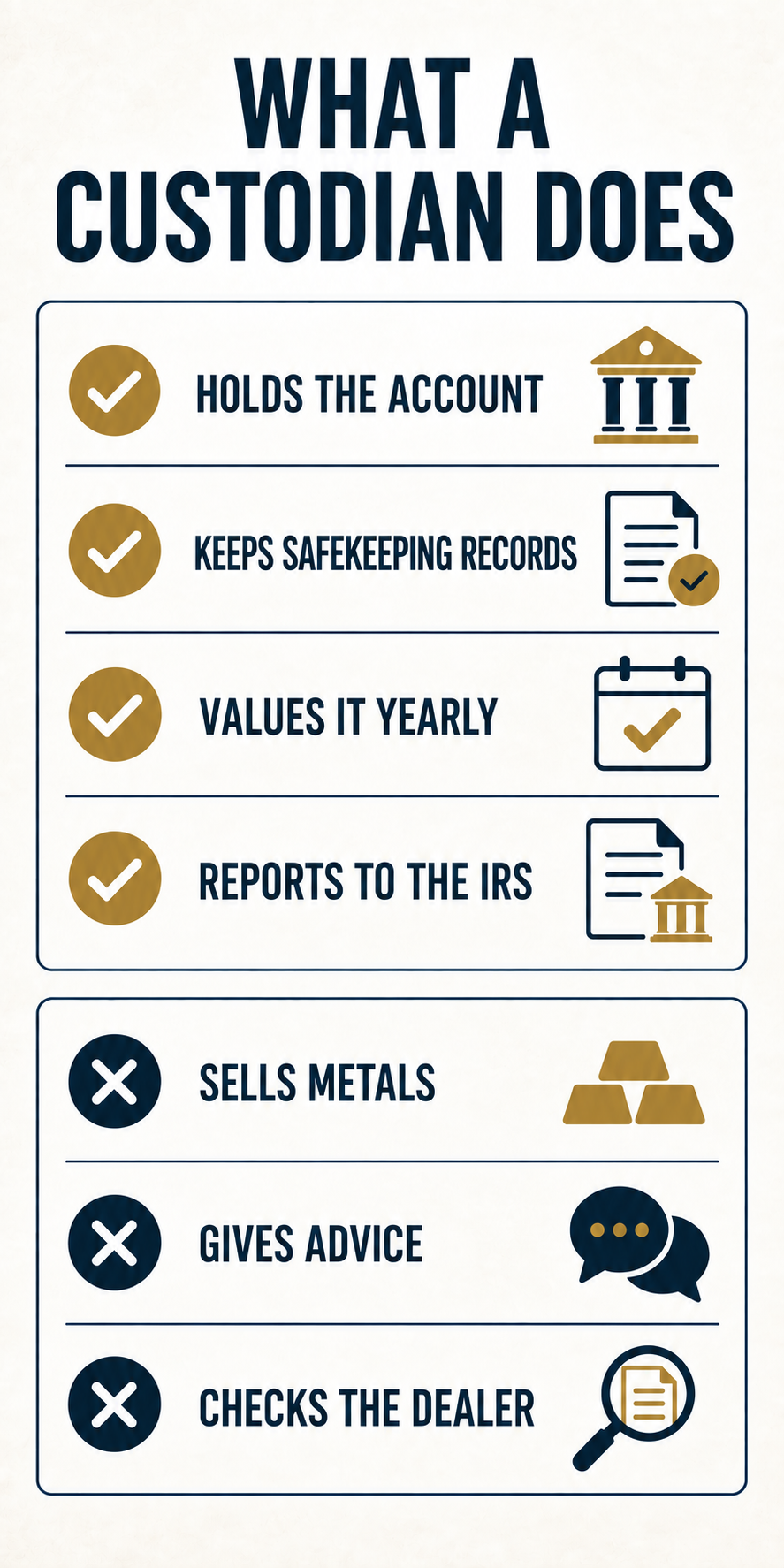
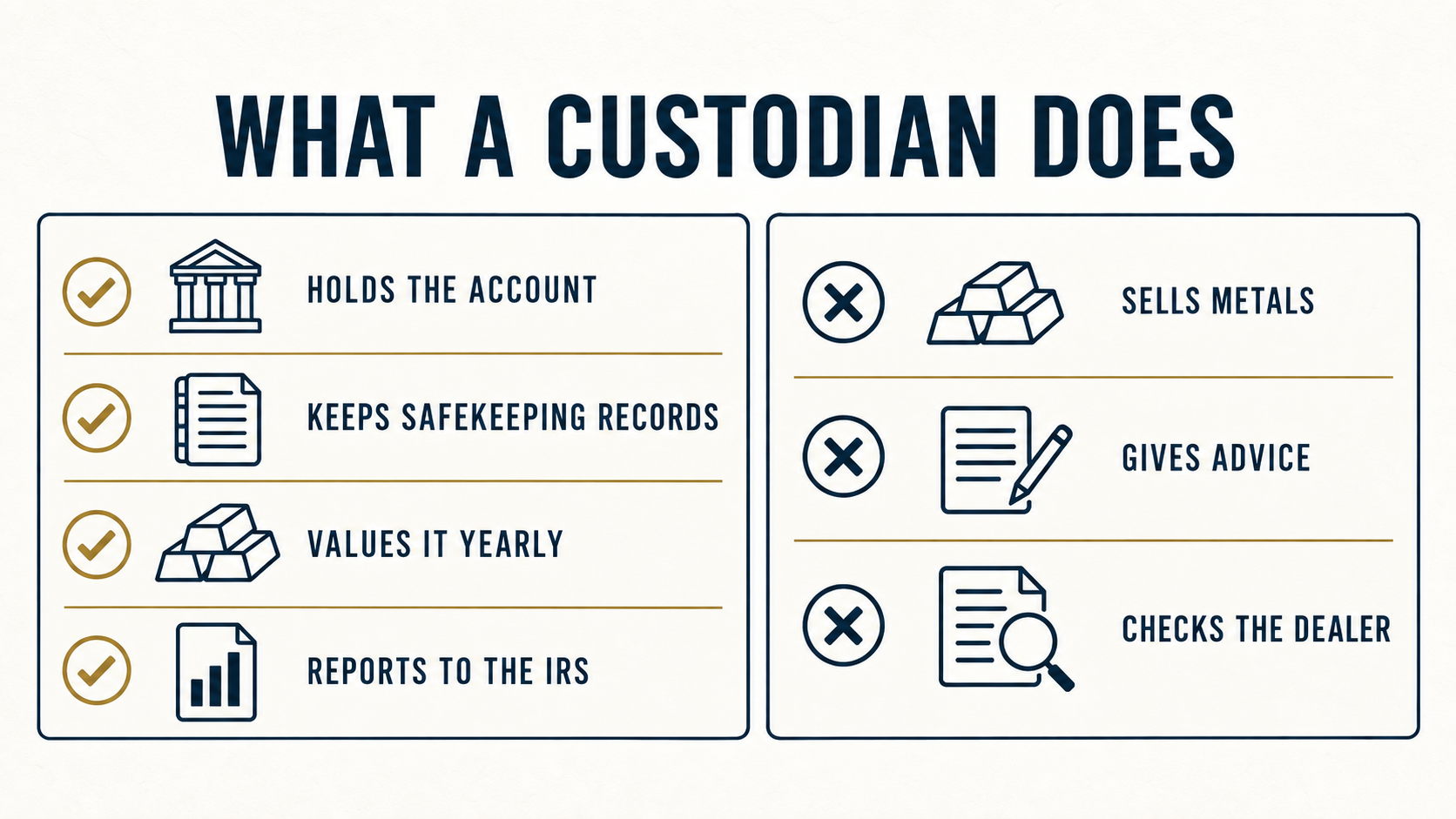
Every gold IRA has a custodian, and most people meet theirs only through paperwork. It's worth knowing more than that. The custodian is the institution the law requires to hold your IRA, and the rules about who can serve, what they must do, and what they don't check all affect whether the arrangement works the way you expect. This page covers those rules and how to verify a custodian before you open an account.
Who Can Be a Custodian
The tax code requires every IRA to have a trustee or custodian that is either a bank or another entity approved by the IRS. Section 408(n) defines "bank" broadly for this purpose:
- A bank or trust company exercising fiduciary powers, as defined in section 581
- An insured credit union
- A state-supervised corporation, meaning one that is "subject to supervision and examination by the Commissioner of Banking or other officer of such State"
Anyone else needs IRS approval as a nonbank trustee. Under Treasury Regulation 1.408-2(e), a nonbank applicant must show the IRS in writing that it will administer IRAs consistently with the law and "demonstrate in detail its ability to act within the accepted rules of fiduciary conduct." A self-directed IRA custodian that handles precious metals can fall into any of these categories, which is why the way you verify one depends on what kind of institution it is.
What a Custodian Does
A custodian's job is administration and safekeeping, and the rules spell out several duties:
| Duty | What the rules say |
|---|---|
| Hold and administer the assets | The SEC, FINRA, and NASAA describe custodians as "only responsible for holding and administering the assets in the account" |
| Safekeep physical assets | Nonbank trustees must deposit assets needing safekeeping "in an adequate vault" and keep "a permanent record" of what goes in and out |
| Value the account every year | Nonbank trustees must value assets "at least once in each calendar year… at their fair market value" |
| Report to you and the IRS | For 2026, custodians must send each account owner a statement of the December 31 value by February 1, 2027, and report it to the IRS on Form 5498 |
| Report distributions | Distributions are reported on Form 1099-R |
On valuation, the IRS instructions add a caution aimed at hard-to-value assets: custodians "are responsible for ensuring that all IRA assets… are valued annually at their FMV." The instructions don't give any metals-specific valuation method.
For metals, the custodian is also the "trustee" that must have physical possession for bullion to qualify, usually by arranging storage at a depository. Our guide to home storage gold IRAs explains why that possession requirement matters.
What a Custodian Doesn't Do
This is the part that trips people up. A custodian's name on your paperwork is not an endorsement of the dealer or the price. The joint investor alert from the SEC, FINRA, and NASAA is blunt:
"Self-directed IRA custodians: DO NOT sell investment products or provide investment advice; DO NOT evaluate the quality or legitimacy of any investment…; and DO NOT verify the accuracy of any financial information."
It adds that "using a legitimate custodian to buy an investment DOES NOT make that investment legitimate," and that "fraudsters often falsely claim or imply that self-directed IRA custodians investigate and validate any investment."
NASAA's 2024 advisory on precious metals says the same about dealers specifically: "IRA custodians do not vet precious metals dealers or their sales practices." Checking the dealer and its prices is up to you. Our guide to checking a gold IRA company covers where to look.
What Custodians Charge
Custodian fees are separate from the dealer's price for the metals. Regulators warn that self-directed IRA fees "may be significantly higher" than conventional IRA fees and can include "account opening fees, annual account fees, administrative fees and asset specific fees."
Fees can add up when a dealer and custodian both take a cut. The CFTC describes one complaint in which "a gold dealer and IRA custodian charged nearly $150,000 in commissions and fees to a customer who rolled over a $300,000 retirement account into a gold IRA." That's an allegation from a complaint, not a court finding, but it shows why you should ask for every fee in writing, from both the dealer and the custodian, before you sign.
How to Check a Custodian
Which check applies depends on what kind of institution the custodian is:
| If the custodian is… | Check here | What you'll see |
|---|---|---|
| A nonbank trustee | IRS list of approved nonbank trustees and custodians | Entities approved under Treasury Regulation 1.408-2(e); the current list is dated April 1, 2026 |
| An FDIC-insured bank | FDIC BankFind | Insured banks, locations, and merger history |
| A national bank or national trust bank | OCC financial institution lists | Downloadable lists of national banks, trust banks, and federal savings associations |
| A state-chartered trust company | The banking department of the chartering state, via the CSBS directory | Many states publish lists of chartered trust companies |
Two cautions. The IRS list covers nonbank entities only, so a legitimate bank or state trust company won't appear on it. And investor regulators note that the IRS resource "is not a complete list of every custodian." If a custodian doesn't appear where you'd expect, ask it directly which regulator supervises it, then confirm with that regulator.
Questions to Ask a Custodian
- Are you a bank, a state-chartered trust company, or an IRS-approved nonbank trustee, and who supervises you?
- What are all of your fees: setup, annual administration, per-transaction, storage, and fees to close or transfer the account?
- Which depositories do you use for precious metals, and do you hold the metals on the IRA's behalf there?
- How do you value the metals for the year-end statement and Form 5498?
- Do you accept the specific products I'm considering? Our guide to IRA-eligible gold and silver explains what the tax code allows.
The Bottom Line
A gold IRA custodian is a regulated institution with specific legal duties: hold the assets, safekeep and value them, and report to you and the IRS. It isn't a gatekeeper for the dealer or the price, and regulators are explicit about that. Verify the custodian through the IRS list, the FDIC or OCC, or its state regulator, and get every fee in writing. Our 401(k) to gold IRA rollover guide explains how money moves into the custodian's account.
Common questions
Frequently asked questions
- What does a gold IRA custodian do?
- A custodian holds and administers the IRA's assets under IRS rules. Treasury regulations require nonbank trustees to value account assets at fair market value at least once a year, and IRS instructions require custodians to report each account's year-end value on Form 5498. The custodian also keeps safekeeping records for assets like metals held in a vault.
- Does a gold IRA custodian check the dealer or the prices?
- No. A joint alert from the SEC, FINRA, and NASAA says self-directed IRA custodians don't sell investment products, don't provide investment advice, and don't evaluate the quality or legitimacy of any investment. NASAA says IRA custodians do not vet precious metals dealers or their sales practices.
- Is there a list of IRS-approved gold IRA custodians?
- The IRS publishes a list of approved nonbank trustees and custodians, most recently dated April 1, 2026. It covers nonbank entities only: banks and state-supervised trust companies can also serve as IRA custodians and aren't on it. Investor regulators note the list is not complete.
- How do I check a custodian that isn't on the IRS list?
- If it's a bank, you can look it up in the FDIC's BankFind tool or the OCC's lists of national banks and trust banks. If it's a state-chartered trust company, check the banking department of the state that chartered it; the Conference of State Bank Supervisors publishes a directory of state banking agencies.
Evidence
Sources
- Internal Revenue Code § 408(a) and (n) (IRA trustees; definition of bank) — Cornell LIIas of 2026-09-24
- eCFR — 26 CFR 1.408-2 (nonbank trustee requirements)as of 2026-09-24
- IRS — Approved nonbank trustees and custodiansas of 2026-09-24
- IRS — Instructions for Forms 1099-R and 5498 (2026)as of 2026-09-24
- SEC / FINRA / NASAA — Self-Directed IRAs and the Risk of Fraud (Investor.gov)as of 2026-09-24
- NASAA — Informed Investor Advisory: Precious Metals and Coin Investments (July 2024)as of 2026-09-24
- CFTC — Precious Metal Fraudsas of 2026-09-24
- FDIC — BankFind Suiteas of 2026-09-24
- OCC — Financial institution lists (national banks and trust banks)as of 2026-09-24
- Conference of State Bank Supervisors — Contact your state bank agencyas of 2026-09-24
Keep researching
Related research
- 401(k) to Gold IRA Rollover: IRS Rules, Steps and PitfallsHow a 401(k) to gold IRA rollover works under IRS rules: direct vs 60-day rollovers, the 20% withholding trap, the one-per-year rule, and mistakes to avoid.
- Home Storage Gold IRAs: What the IRS and the Tax Court SayCan you keep IRA gold at home? What the tax code, the IRS, and the Tax Court's McNulty decision say about home storage and IRA-owned LLCs, and what it cost.
- How to Check a Gold IRA Company and Spot a ScamRetail metals dealers aren't federally regulated, so checking falls to you. Where to look, the red flags regulators list, and what enforcement cases found.